
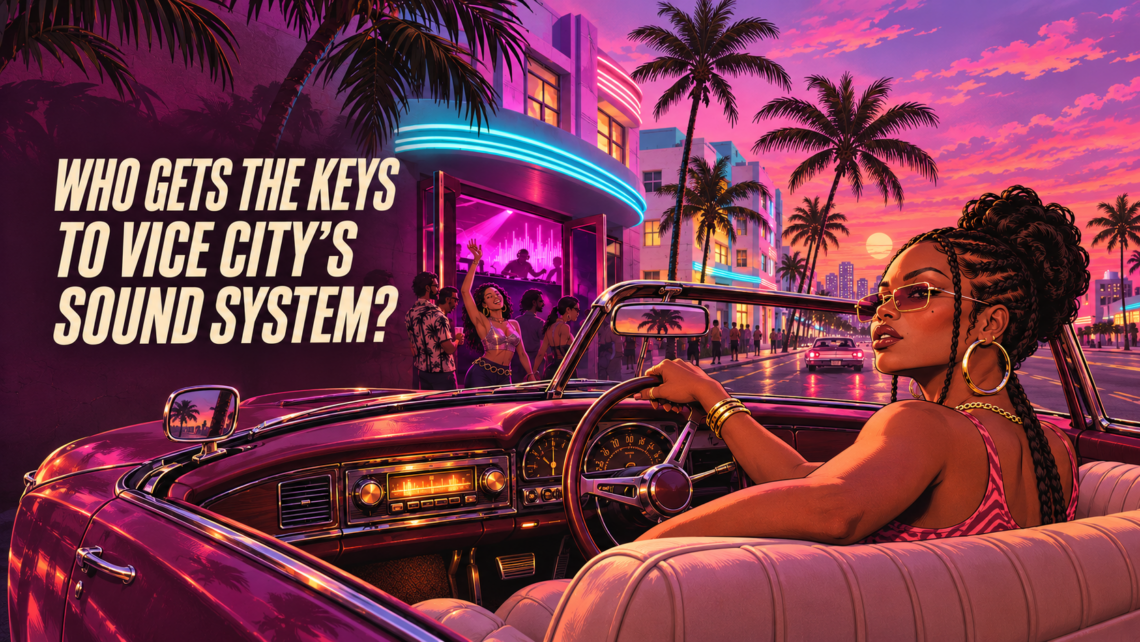
Who Gets the Keys to Vice City’s Sound System?
From a nightclub flyer to a Haitian anthem on the car radio, Grand Theft Auto VI reveals how much of Miami you can hear when somebody local gets to pick the records.
By Lisa Ford, creator of HIP HOP ORGY
Jason and Lucia pull into traffic in a beat-up convertible. As the canvas top folds back, Depeche Mode’s “People Are People” comes over the car radio, a detail Joe Donnelly picked out in Rockstar’s filmed preview of Grand Theft Auto VI. It’s a good record for putting the top down. But if you closed your eyes, what would that song alone tell you about Miami? What would you learn by turning the dial? rockstargames.com
I lived in Miami before moving to San Francisco. I’m perfectly willing to believe somebody in that convertible wants to hear Depeche Mode. People are entitled to a British synth-pop record in South Florida. What interests me is who gets the next few minutes of airtime. A programmer who follows that record with another ’80s favorite can keep you in a decade. A DJ who gives you Black Dada’s “Imma Zoe” can put you at a South Florida neighborhood party in 2009. Miami New Times
Rockstar released GTA VI on November 19. Its Vice City is a fictional Miami where the driver can choose a radio station, and some of the best programming requires getting out of the car first. For a music fan, that makes for a pretty good night out. When you leave the club and turn on the radio in Vice City, whose Miami do you hear? Rockstar Games
Listen at 8:20 – the convertible scene at 8:21.
Taking The Vault on the Road.
Inside The Vault nightclub, look for a poster of a gas mask covered in flowers. Donovan Erskine of Shacknews found it near an ATM. Scan the poster with the character’s phone and The Vault Radio becomes available in the car. Of all the things a developer could ask a player to do to earn a reward, I’m partial to this one. Somebody made a flyer good enough to stop you on your way past the cash machine. Shacknews
The Vault takes its cues from Miami’s Club Space. Ivan Pavlovich, Rockstar’s vice president of music and a former Chicago club DJ, told The New York Times that his team worked on how the dancers respond to what the DJ plays. It’s the part of DJing you’d miss if you spent the night looking over the booth at the decks. Turn around. The people on the floor are telling you what they think of the last record. The next selection is your reply. Circoloco Ibiza
The poster lets the club’s taste travel. Among the selections PC Gamer documents on the unlocked station is DJ Koze’s “XTC.” You can go looking for that record later because you remember where you found it. I like that little concession to how people actually get into dance music. Ask somebody to name a track from a great night out and they might draw a blank. Ask where they were standing or who had the booth and suddenly you’ve got a story. PC Gamer
In South Florida, the car waiting outside deserves a production credit of its own. Consider DJ Billy E, who installed car stereos before he started making tracks in the early ’90s. One reason to make his own music, WLRN reported, was to find out what the systems could do. He spent his first royalty check on a blue van and put a wall of subwoofers where passengers might ordinarily sit. The best seat for hearing the results was directly in front of them. WLRN
Think about the order of operations. A man fits speakers into cars. He needs material that will tell him how well they work, so he makes records. The records earn him money to build a better place to play them. His collaborator Neil Case, who records as Bass Mekanik, learned his low end working in Jamaican reggae studios. Between those two men you have a studio education, an installer’s ear and a passenger seat where any theory about how much bass is enough can be settled in person. That’s a piece of Miami music history I want riding along when the game hands you the keys. WLRN
Trick and Trina have done mornings
Turn to Dirty South Classics and two Miami rappers get the microphones. Trick Daddy and Trina had already done a version of this job for an audience with actual traffic to sit in. In 2020, they hosted a morning show on Miami’s 99 JAMZ. They had an even earlier audition for the way two voices could share a frequency. Put on Trick’s 1998 single “Nann” and wait for Trina’s turn. The pleasure of the exchange is how thoroughly each believes they deserve the last word. au.rollingstone.com
Slip-N-Slide Records founder Ted Lucas helped curate Dirty South Classics, according to CBS Miami. His label had put out the Trick Daddy album that introduced a national audience to Trina. Now all three have a say in how listeners meet Southern rap inside a video game. That’s an unusual second act for a label boss and two artists. Stay in music long enough and somebody may hand you the oldies station. Get the right people behind the microphones and suddenly “classics” sounds like a claim you could argue about over breakfast. CBS Miami
Take “Born-N-Raised,” the 2006 DJ Khaled record on the station. Trick Daddy, Rick Ross and Pitbull each get a verse. The billing itself tells a story about how a DJ can put a city on record. Khaled’s name holds the piece together while three rappers get to answer for the place they come from. And in Vice City, Trick does double duty. The man with a verse on the record is also one of the people entrusted with the station that plays it. For somebody meeting him here first, there’s a whole career in the distance between those two microphones. au.rollingstone.com
What “Imma Zoe” carries
There’s another station you have to go looking for. The Sniper of La Perle opens up after players scan four posters around La Perle, Vice City’s take on Miami’s Little Haiti. Two of the stops are a tattoo shop and Aunt Zola’s Soul Food. The geography matters, including where it extends beyond Miami. The host, Kodak Black, grew up in Pompano Beach, in Broward County. The producer who presents the station, Michaël Brun, was born in Haiti. PC Gamer
Brun told the Miami Herald’s Jacqueline Charles that he and Kodak spent years working on the project. They picked music made in Haiti alongside records by Haitians in Miami. You can hear the scope of that decision in a pair of titles on the dial. There’s Zenglen’s “Child Support,” a way into the station’s konpa programming, and there’s Black Dada’s “Imma Zoe,” a record that Miami New Times places in the neighborhood parties of South Florida’s jook era. A DJ making room for both gives a newcomer two very different answers to the question of what Haitian music sounds like. ArcaMax Publishing
Black Dada, born Davidson Pierre, knew how to write a hook for other people to carry. Read the few lines he puts on his own website. He introduces himself, dedicates the record to his island, then repeats the image of the tattoo on his chest before he gets to the word Zoe. I love the order of that introduction. By the time you hear the name he claims for himself, you know where he wears it. A crowd can sing the first person along with him. Everybody gets to say I. blackdada.com
In 2009, “Imma Zoe” was getting spins on both 99 JAMZ and Power 96. Years before you could unlock it in a game, somebody in a real South Florida car could catch it on either station. That’s the history I’d keep in mind when the hook comes around again. Black Dada made a declaration of Haitian pride that people could dance to. Local radio carried it. Brun and Kodak understood why another generation ought to get a turn with it. Depeche Mode can have the convertible. “Imma Zoe” is the record I’d circle the block to finish. South Florida Caribbean News
If there’s a record you’d circle the block to finish, you’re my kind of reader. Subscribe to HIP HOP ORGY, my independent hip-hop magazine on Substack. www.hiphoporgy.substack.com
Listen and Sources
- Start in the convertible. Rockstar’s extended look, cued to 8:21 · Joe Donnelly’s account of the radio scene · Official music credits
- Find The Vault. Ivan Pavlovich on Club Space and the dance floor · The poster, photographed in-game · Both unlockable playlists
- Hear the bass. WLRN with DJ Billy E and Bass Mekanik, 4:20 segment
- Tune in to Dirty South Classics. Rockstar’s station preview · CBS Miami on Ted Lucas · Rolling Stone on Trick, Trina and the records
- Follow “Imma Zoe.” Black Dada’s lyrics and video · Michaël Brun’s interview with Jacqueline Charles · Miami New Times on jook · The single on Miami radio in 2009


You May Also Like

THE TASKMASTERS!! …EP 3 Is Finally Here!!! [Video]

Beyoncé Launches The “Formation Scholars” Scholarship Program via @lisafordblog
